Teaching English Language Learners Through the Arts a Suave Experience
Geri McClymont is passionate virtually pedagogy. She holds an MEd and has taught English language learners for over ten years.
Be intentional almost using effective strategies in class to help your English learners succeed
Pixabay fifty modified
Co-ordinate to the National Teaching Clan, English language learners represent the fastest growing student population group in the U.Southward. Information technology is estimated that past 2025, 25% of our public school students will be ELLs.
With the increasing number of English learners inbound our classrooms comes a pressing demand for teachers to use strategies to support them academically.
Here are 15 ways assistance your English learners at all grade levels be successful in schoolhouse. These approaches can be used in classes composed of only ELLs and in mainstream classes composed of ELLs and not-ELLs.
Strategies to Back up ELLs in Class
- Speak slowly and clearly.
- Utilize fewer words.
- Permit more wait time.
- Model what you teach.
- Use many visuals.
- Use graphic organizers.
- Teach vocabulary.
- Build on background knowledge.
- Implement cooperative learning activities.
- Use student-friendly handouts.
- Modify grade textile and assessments.
- Allow ELLs to use linguistic communication resources.
- Pair your ELL with a buddy.
- Provide routine and structure.
- Create a welcoming classroom environment.
Speaking slowly and clearly is one of the almost underrated yet well-nigh constructive strategies teachers can use to help English language learners succeed in schoolhouse.
— Author

This is what you sound like to ELLs when y'all say as well much or speak too fast.
Pixabay
1. Speak Slowly and Conspicuously
Because many of your English linguistic communication learners are not exposed to spoken English in their homes, you are a primary model of the English linguistic communication for them!
Take total advantage of this opportunity to model appropriate grammar and pronunciation in the classroom.
Just as important is that y'all not speak too fast. Since English isn't their first language, ELLs need more than time to process what they hear in English in order to make sense of it. The faster you talk, the harder it is for them to process and make sense of what you say.
Make sure you enunciate clearly and if you're a fast talker, deadening down!
Examples of How to Utilize Fewer Words
| Too Many Words | Fewer Words |
|---|---|
| "Today you're going to piece of work on your advert posters and so we need our class helpers to please hand out everybody'due south posters." (discussion count: 21) | "Today you'll work on your ad posters. Class helpers: please mitt out the posters." (word count: 14) |
| "What do you lot recall is a skillful fashion to get your readers' attention when you lot begin your story so that they want to go along reading your story?" (word count: 27) | "What is a good way to get your readers' attention when you brainstorm your story?" (word count: 15) |
| "At that place are three different kinds of sentences nosotros're going to talk almost today. Nosotros have statements, we have questions, and we have exclamations." (word count: 23) | "Today we'll look at three kinds of sentences: statements, questions, and exclamations." (discussion count: 12) |
two. Use Fewer Words
Along with speaking more slowly and clearly, simply equally important is that you not over-saturate your English language learners with auditory input.
Say what you need to say as concisely every bit possible, using merely the words necessary to convey your message. Get out out the "fluff"—words that are superfluous and don't add any value to your message.
Less is more, so speak in chunks. If yous have a lot to say, use several short sentences with pauses in betwixt, rather than 1 long, drawn out sentence.
Whorl to Continue
Read More than From Owlcation
Speaking concisely and in chunks facilitates comprehension and decreases stress for your ELLs because they have fewer words to process at a time.
As their English proficiency increases, you can begin to gradually incorporate more than words as well as richer vocabulary into your speech.

ELLs need more time to procedure what they hear in English, and then allow sufficient wait time after you ask a question.
Pixabay
three. Permit More than Look Time
Not only do English language learners need more than time to process what they hear in English language, they besides need more time to formulate a response in English when asked a question.
This means y'all need to allow sufficient expect time after you pose a question.
Exist patient. Pose the question to the whole class. Interruption. Glance around the classroom at all of your students and so you're not singling anybody out. Then call on a specific student to reply the question.
When your ELLs know you're offering everybody in the course extended wait fourth dimension, they'll feel more at ease raising their hand to volunteer a exact response.

Modeling is a critical part of the pedagogy process, and is especially of import for English language learners.
Pixabay
four. Model What Yous Teach
Prove your English language learners what you desire them to do.
Utilize actions and gestures to accompany your words equally much as possible, such every bit when yous explain the process for grade routines.
Physically walk around the room and demonstrate exactly what they should do each pace of the fashion.
Use your hands, facial expressions, and your whole trunk to make your words meaningful to your ELLs.
When teaching a concept, model several examples of the application of the concept, and gradually involve your students in the procedure before you ask them to apply the concept independently.
This "I do it, nosotros exercise information technology, y'all do it" approach gives students confidence as it enables them to really grasp the concept you're teaching.
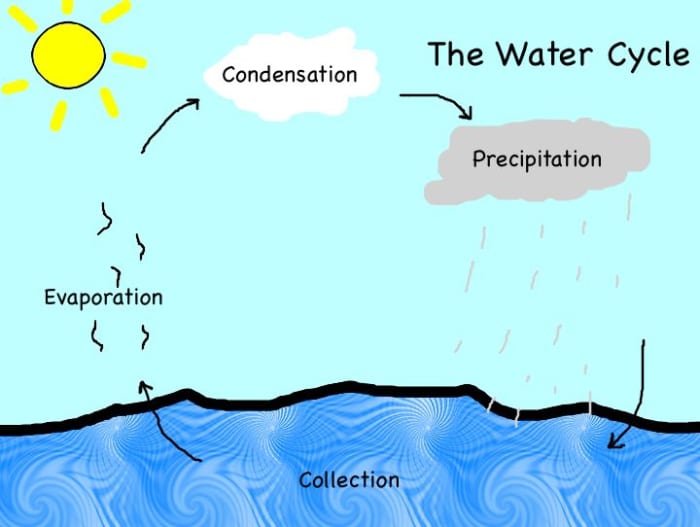
A clear, colorful image of the water cycle. Visuals are invaluable in helping ELLs brand sense of new content.
Pixabay
v. Utilize Many Visuals
The value of visual aides in helping English language learners comprehend subject matter cannot be overstated. Be certain to use visuals equally a regular part of your lessons to aid your students understand the concepts you teach.
Your lessons will make significantly more sense to them when they meet images connected to what you say.
Some images you might utilise in your lessons:
- posters
- photographs
- illustrations
- tangible items
- brusque video clips (the internet is loaded with brusque, educational videos)
- charts
- tables
- graphs
- maps
Maximize your classroom wall space past hanging posters of concepts you are instruction, and by creating word walls of key vocabulary you are focusing on.
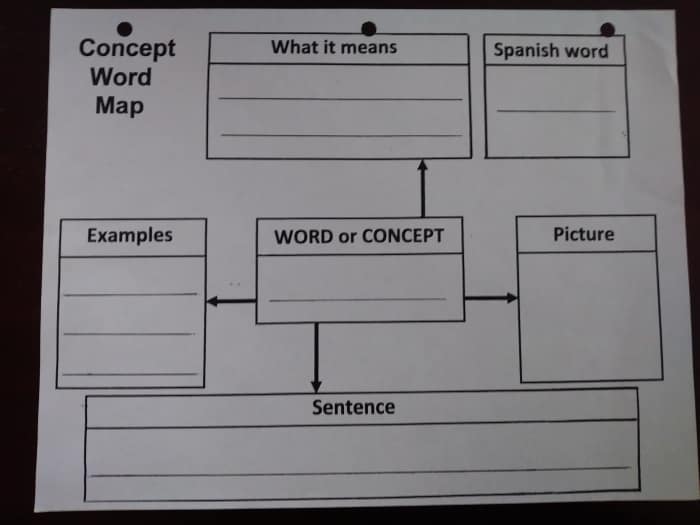
Utilise graphic organizers to help your ELLs make sense of new data.
Geri McClymont
vi. Use Graphic Organizers
Graphic organizers are excellent visual tools for organizing data to facilitate students' agreement of content.
Some examples of graphic organizers:
- Concept maps: diagrams that shows the relationship betwixt concepts
- Menses chart: diagrams that shows the sequence between deportment or functions involved in an activity
- Venn diagrams: diagrams that brandish the similarities and differences between ii or more than concepts
Display graphic organizers on your big screen with a document camera or but draw them on the board. Equally you fill them in, let your students to fill in their own copies to help them make sense of what they're learning.
Visual organizers also serve as excellent study guides for English learners. Considering the information on them is laid out so clearly, your students can make sense of them independently after they leave your classroom. They can utilize them to review and study for upcoming quizzes and tests.

Create a presentation of each vocabulary give-and-take you innovate.
Pixabay I text added by author
7. Teach Vocabulary
Lack of bookish vocabulary is one of the greatest barriers ELLs come up against in schoolhouse. For this reason, information technology's critical that teachers be intentional well-nigh educational activity vocabulary to their English learners.
Because many non-ELL students also lack vocabulary skills, they too can benefit from classroom vocabulary education!
Suggestions:
- Pre-teach key vocabulary: A meaning way to assist your ELLs understand content is to make information technology a habit to pre-teach key vocabulary before reading new text. Create discussion presentations on PowerPoint slides, on Word documents, or on posters to include the discussion, an epitome, a concise definition, and a judgement containing the word. (see instance above)
- Word Journals and Give-and-take Maps: Encourage your students to keep a journal of word maps for all new vocabulary they learn. This gives them something tangible to study during the school year, and something to take home at the end of the year.
- Word walls: Showroom words you are learning on your wall, along with a visual for each one. Use it as a reminder of all the vocabulary you've covered and then far!
- Word sorts: Ask students to categorize words based on common features and characteristics.
- Quick Sketches: Keep dry erase markers handy at all times for sketching on the lath on the spur of the moment to help clarify unfamiliar words you come up across in text. Your students will love your drawings and your efforts to help them grasp new concepts.
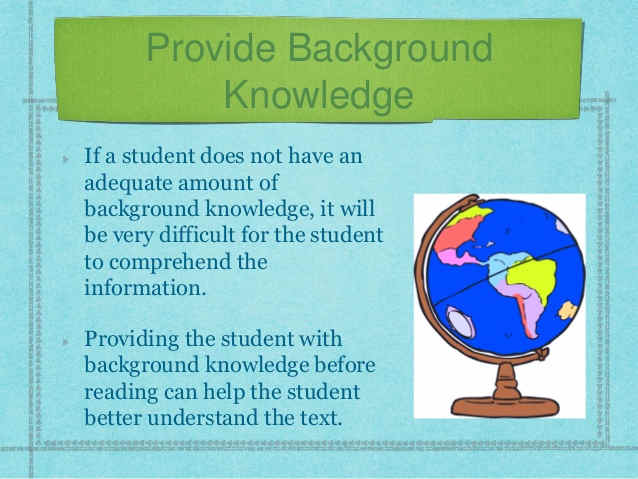
Providing your ELLs with background knowledge better enables them to understand new content.
Pixabay
8. Build on Background Noesis
When you make connections between what your students already know and new concepts y'all present, lessons are more relevant and meaningful to them.
Your English language language learners will experience a boost of confidence when they realize what they already know in connection with new concepts y'all teach. This will pump them up to larn new material!
On the other paw, because of their diverse cultural and educational backgrounds, many ELLs lack groundwork knowledge in some subject areas.
Before presenting new cloth, review groundwork knowledge with your entire grade to lay the foundation for the new content. This will refresh your non-ELLs' memories while at the aforementioned time aid make full in the gaps for your English learners.
Apply realia, videos and images to help build background noesis for your ELLs and to help them sympathize new content.

Students engaged in a cooperative learning activeness in class.
Pixabay
9. Implement Cooperative Learning Activities
Including pair-share and pocket-sized group activities as a regular part of your lessons allows your ELLs many opportunities to practice English in ways that are fun and natural.
- Pair each of your less good ELLs with a native English language speaker or a fluent ELL. This allows ELLs to hear right English modeled to them and to practice their English language in a less intimidating setting inside the classroom.
- Decide which partner volition exist "A" and which will exist "B".
- After you pose a question, allow sufficient wait time for your ELLs to process the question and to formulate a response.
- Ask partner "A" to tell his partner his answer, permit sufficient time, and and then ask partner "B" to exercise the same. You may want to have your more than proficient students answer kickoff, so that they tin can model right English grammar to your less proficient students.
- When students have finished pair-sharing after each question, call on volunteers to share their responses with the whole class.
Small Groups
Placing your ELLs in small groups enables them to collaborate with students they may usually not have a gamble to interact with. Information technology besides helps them acquire important social skills such as getting along with students who may be very dissimilar from them.
Cooperative learning activities have proven to be highly successful for engaging all students in the classroom!
Dr. Spencer Kagan'southward book, Kagan Cooperative Learning, is an fantabulous resources for implement a variety of cooperative learning activities. The volume also offers ways to designate specific roles to students to help ensure that they all participate as within groups.

It'southward important to keep the layout on handouts uncluttered for English language learners so they tin focus on the essentials.
Photo past Jessica Lewis on Unsplash
10. Use Student-Friendly Handouts
ELLs are often overwhelmed by the amount of print on school handouts they're given. It'due south no wonder, as many school papers are over-saturated with visual input. In modern terms, they're "besides decorated."
It's very important to ensure that all handouts (including worksheets) we give our English language learners are educatee-friendly.
What does a pupil-friendly handout await similar?
- The layout makes sense and facilitates understanding of the content.
- The print is legible and large enough for students to read.
- Sections of the handout are spread out with sufficient space in between.
- At that place isn't an excessive amount of print on the page.
- If there's a word banking company, the words are enclosed in a box.
- All data on the page, including directions, is clear and concise.
When it comes to whatsoever kind of handout, less is more for ELLs because it helps them focus on the essential data on the page without unnecessary distractions.
The Five Stages of Language Conquering
| Stage | Characteristics | Judge Time Frame | Teacher Prompts |
|---|---|---|---|
| Preproduction | "Silent period", nodding yes or no, pointing, drawing, limited comprehension | 0-6 months | "Bespeak to...", "Circle the....", "Show me..." |
| Early on product | ane-2 discussion responses, uses present tense verbs and key words, limited comprehension | 6 months-1 twelvemonth | Aye/no questions, questions that require one-2 word responses, "Who...?" , "What....?", "Where...?" |
| Emergent spoken language | short phrases and sentences, errors in grammar and pronunciation, adept comprehension | 1-3 years | Questions that require short phrase or curt sentence responses, "How...?", "Why...?" |
| Intermediate fluency | longer sentences, few grammatical errors, very good-excellent comprehension | 3-5 years | Questions that require more than thorough responses, "Explain....", "Compare...." |
| Advanced fluency | virtually-native speech, excellent comprehension | v-7 years | "Retell....", "Support your reply." |
xi. Modify Material and Assessments
It's non merely handouts that need to be presented to ELLs in a uncomplicated format—other course fabric and assessments often do, besides.
Textbooks
Textbooks in unproblematic schoolhouse tend to be very student-friendly and so they frequently work fine for ELLs. They're written at a lower reading level and frequently have key concepts and vocabulary highlighted or colour coded.
All the same, middle and loftier school textbooks are likely to be also hard for ELLs and then modifications will need to be made.
Suggestions:
- Highlighted text: Set aside some of your class textbooks just for your ELLs. Highlight the key concepts and vocabulary in the text to facilitate your students' power to focus on the almost essential information without beingness overwhelmed. Teach your ELLs to read simply the highlighted sections.
- Audiobooks: Find out if there is an sound version of your class textbook online or on CD so that your ELLs tin can listen as they read along. If at that place isn't, consider recording the key, highlighted points of the text for your students so they tin heed every bit they follow along in the book.
- Supplemental material: Await for easier books or articles with many visuals that embrace the aforementioned content that is in the textbook. You can also create written summaries of the content for your ELLs with plenty of visuals to help their agreement. Readworks.org is an excellent website that offers gratuitous reading material across a wide range of topics (both fiction and nonfiction) at various reading levels for each specific topic. BrainPop, a popular educational website, offers videos of subject field thing in all content areas in both English and Spanish.
Classwork and Assessments
It's vital to know the language conquering stage of each of your ELLs so that your academic expectations of them are realistic (run into chart above). You don't want your ELLs to close down because your expectations are beyond what they're nonetheless capable of producing.
Ensure that the layout for all classwork and assessments is straighforward then that your ELLs tin focus on showing you what they've learned rather than on trying to make sense of what they're being asked to practise.
Consider reducing classwork:
- Enquire students to complete merely a portion of worksheets you assign. For instance, only the front end side or just the start department. As their English skills develop, you tin gradually ask them to consummate more sections on the worksheets.
- For writing assignments, ask students to produce i sentence instead of one paragraph, or one paragraph rather than three. Don't place besides much emphasis on grammar and spelling at outset—remember that writing is usually the final of the linguistic communication domains to develop (afterward listening, speaking, and reading).
Modify assessments:
- Graphic Organizers: Enquire your ELLs to consummate a concept map, a flow nautical chart or another graphic organizer they've used in class to prove you their understanding of concepts you've taught.
- Categories and Lists: Have your ELLs create discussion lists or to sort words into categories based on mutual features and characteristics.
- Read Assessments Aloud: Read assessment directions, questions and multiple response options aloud to your students. Permit sufficient time for them to procedure what they hear and to respond.
- Oral or Picture Responses: Allow your ELLs to respond to assessment questions verbally or by cartoon pictures.
- Native Language Assessments: If your ELLs are literate in their native language, offering them the assessment translated into their native language. Google translate unremarkably produces very accurate translations and is free. BrainPop offers Spanish quizzes on a wide range of topics across all content areas.
When you lot change material and assessments for your English learners, information technology's important to not unmarried them out, equally this may embarrass them. Instead, quietly communicate your expectations to them before or during grade. Nobody else needs to know.

Testify your ELLs how to utilize resources that will support them in grade.
Pixabay
12. Permit ELLs to Utilise Resource
Introducing your ELLs to linguistic communication resources will help reduce their anxiety as they larn English and effort to catch up academically with their form level peers. Exist sure to have these resources bachelor for them in your classroom.
If you lot need copies, talk to your school ESL department and school library, as they should have some available for classroom use. Show your students how to use these materials to help them with classwork and assessments.
Some resource to introduce to your ELLs:
- Motion-picture show Dictionaries: These books are rich in colorful images to aid ELLs acquire new vocabulary. Words in these dictionaries are arranged thematically, such every bit Places in the City, Outdoor Activities, and Types of Vehicles. Some of these dictionaries are bilingual while others are but in English.
- Bilingual Dictionaries: These books provide students with the translation of words from English language into their dwelling house linguistic communication. Bilingual dictionaries are available in all of the most commonly spoken languages and enable students to apace reference unfamiliar words they come across in text.
- Glossaries: These resources contain key vocabulary specific to a subject, such as Science, Math, or Social Studies. Some are bilingual, while others are only in English language. Glossaries can be very instrumental in helping ELLs succeed in mainstream content area classes.

Pairing a new English learner with a buddy is a significant way to boost her confidence.
Pixabay
thirteen. Assign Buddies
Imagine how some of your English language learners experience when they suddenly observe themselves in a new school, while at the same time adapting to a new culture which includes, among many other things, learning a new language.
Many ELLs are too survivors of trauma which they experienced in their home country prior to immigrating or in the process of coming to the U.S. This adds a whole new dimension to the stress they're experiencing.
A significant way you tin help alleviate some of that stress is past assigning each of your newer or less proficient ELLs a buddy.
How to select a buddy:
- When possible, choose a student who speaks the same kickoff language every bit your new ELL.
- Select a student with a college English language proficiency level than your new ELL.
- Patience and kindness are important attributes to look for in a buddy.
Seat your newer ELL beside his buddy in your classroom then that the students tin work together during grade projects and assignments.
This support will give your newer educatee a sense of reassurance and belonging in your classroom. He will besides gradually feel more confident equally his new friend assists him in learning English language.
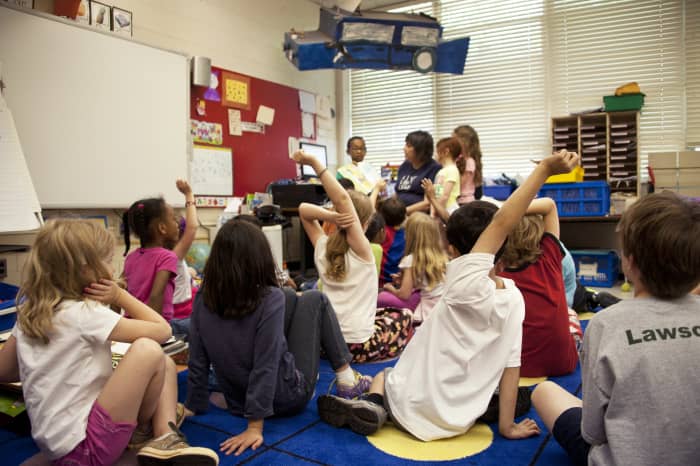
Routine and structure in the classroom help ELLs experience at ease, as they provide them with a predictable and consequent surround.
Photo past CDC on Unsplash
14. Provide Routine and Structure
Most teachers are well aware that classroom routines and construction do good all students. However, routine and structure in the classroom particularly help English language learners because of the many changes they are already going through in their personal lives.
Establishing a regular routine and construction in the classroom helps reduce their anxiety as it provides them with a predictable and consistent surroundings.
Some means to implement routine and structure in the classroom:
- Take a regular morning process for omnipresence, tiffin count, morning announcements, and other daily items.
- Keep classroom materials and supplies such as pencils, newspaper, and mucilage in the same location, such as on a table in the corner of the room.
- Have a clear procedure for transitions, such equally when going to the library or to lunch. For example, all students push button their chairs in, line up by the door and expect for you to lead them.
- Ensure that grade rules and expectations are articulate and enforced from the beginning of the school year.
15. Create a Welcoming Surroundings
Creating a welcoming classroom environment is invaluable in helping your ELLs succeed academically. After all, if they don't savour coming to your grade, they are unlikely to pay attending, participate or put forth much endeavor in learning or completing whatever work you give them.
Suggestions:
- Learn about their civilization: Read up a little on their state of origin so you lot can better sympathize them. Learn about their native foods and customs and utilise this information to engage in conversation with them and their families when yous accept a chance.
- Have mistakes with grace: A classroom where students feel comfortable making mistakes is one in which they are certain to grow non merely academically but also to grow into more compassionate and empathetic human beings. Teach your students that making mistakes is a natural part of learning. This will build your ELLs' confidence in your classroom.
- Read about people of different cultures: Reading about minorities who take suffered many hardships, yet fabricated significant contributions to society is a meaningful fashion to help your non-ELLs have a greater awareness of some of the challenges English learners face up. It's also a nifty way for your form to larn nearly other cultures.
- Praise students for showing kindness: When you catch 1 of your students treating a classmate kindly, point information technology out so they know information technology's of import. Show them how to encourage each other and to lend a helping hand to one another when needed. Share personal stories of how people in your life have stepped in to help you when y'all most needed it, and of the deviation that made for you.
Continue in Heed
Whether you teach a class equanimous of all English linguistic communication learners or a mainstream grade in which you lot take a mix of ELLs and not-ELLs, continue in mind that many of these strategies will assistance not but your English learners, but your other students as well, including slower processors and special needs students.
By practicing these strategies, you're sure to run into a gradual, notable improvement in your ELLs' level of involvement and academic success in your classroom.
Be patient with your English learners simply also with yourself as you become accustomed to applying some of these tips.
Be consistent in using them. Your ELLs will appreciate your efforts to assistance them succeed and to prove you what they are capable of!
© 2016 Geri McClymont
Geri McClymont (writer) on August 07, 2016:
Thanks for your feedback, Paul. It's encouraging to see positive results in our students when nosotros apply strategies that work. Educational games are smashing too!
Paul Richard Kuehn from Udorn City, Thailand on August 06, 2016:
I used your v strategies for ELL when I was teaching EFL in Thailand. The utilise of visuals and cooperative learning activities are particularly of import. My students likewise did very well learning by playing an educational game. Thank you for sharing an excellent commodity!
Geri McClymont (author) on August 06, 2016:
Thanks for your comments, Ann. It is always so rewarding to see our students progress academically and to see their cocky-confidence in the classroom increase too!
Ann Carr from SW England on Baronial 06, 2016:
Presumably some of these students accept actress English language lessons anyhow, outside the classroom. This will evidently boost their learning potential. Your communication is first-class; information technology'due south always good to use any of your points any the pupil as all these things promote further learning and cocky-confidence.
Well written and informative.
Source: https://owlcation.com/academia/5-Easy-Strategies-to-Help-English-Language-Learners-Succeed-in-Your-Classroom
0 Response to "Teaching English Language Learners Through the Arts a Suave Experience"
Post a Comment