The People makingschistory the Global Fight Agains Schistosomiasis
For the first time since the pandemic, I am finally able to travel to sub-Saharan Africa. It'southward a region I accept visited oftentimes for my piece of work fighting neglected tropical diseases (NTDs) that are a meaning burden beyond the region.
As I prepared for this trip, I reflected on a rare upside of the globalized nature of COVID-19: that it has sensitized people around the world to the debilitating impact of infectious diseases on individuals, families, and entire communities. My hope is that this shared experience can interpret into greater support for combating many other diseases that are interrupting millions of lives every day.
That includes the NTD that was a focus of my contempo trip to Ghana. Schistosomiasis is a disease rarely seen in wealthy countries. It's often misunderstood and misdiagnosed fifty-fifty in sub-Saharan Africa, where more than than 200 million people are at run a risk. Schistosomiasis is acquired past tiny larvae of parasitic worms found in fresh h2o. The worms penetrate the skin when a person is in contact with infested water and in one case in the torso, mature into adults where they tin cause a broad range of problems, including damage to the liver, kidneys, and bladder.
The worms penetrate the skin when a person is in contact with infested water and one time in the body, mature into adults
I'm working on a project called the FGS Accelerated Scale Together (FAST) Parcel projection with a coalition of organizations and health professionals who focus on a specially terrible manifestation of schistosomiasis called female genital schistosomiasis (FGS), which currently affects well-nigh 56 million women in Africa. FGS does non just bear upon the float, it affects the whole pelvis including the genitals and can produce vaginal discharge, pain with intercourse, bleeding, and infertility. It tin can also lead to an ectopic pregnancy—a life-threatening condition when a pregnancy occurs outside the uterus.
Many symptoms of FGS are similar to symptoms for other weather. Information technology is routinely misdiagnosed as a sexually transmitted infection (STI) considering wellness-care providers are not aware of it. This contributes to social stigma and fifty-fifty domestic abuse from husbands who mistake FGS symptoms equally prove of infidelity.
The high incidence of FGS in African women is linked to the fact that women and girls in resource-poor areas are frequently in charge of laundry and collecting water for the household, activities that increase their exposure to rivers and other freshwater sources that harbor schistosomiasis parasites.
In our FAST workshop, Nurse Ruth Allotey of the Korle-Bu Teaching Hospital in Accra, Republic of ghana, shared a case that still torments her today. A woman in her mid-thirties came to see her with vaginal discharge, abdominal pain, and irregular bleeding. She had sought care and handling from a chemist store, pharmacy, her local clinic, an urban dispensary, and even an obstetrician-gynecologist—referred from place to place considering her symptoms did non resolve. She spent a lot of coin and even lost her chore in the process of seeking care. She came to Nurse Allotey for assistance simply sadly, she also did non know what was wrong. Now, after this preparation workshop, Nurse Allotey recognizes that this was a clear case of FGS that could have been easily treated and she is trying to find the patient to ensure she gets the handling that she needs and deserves.
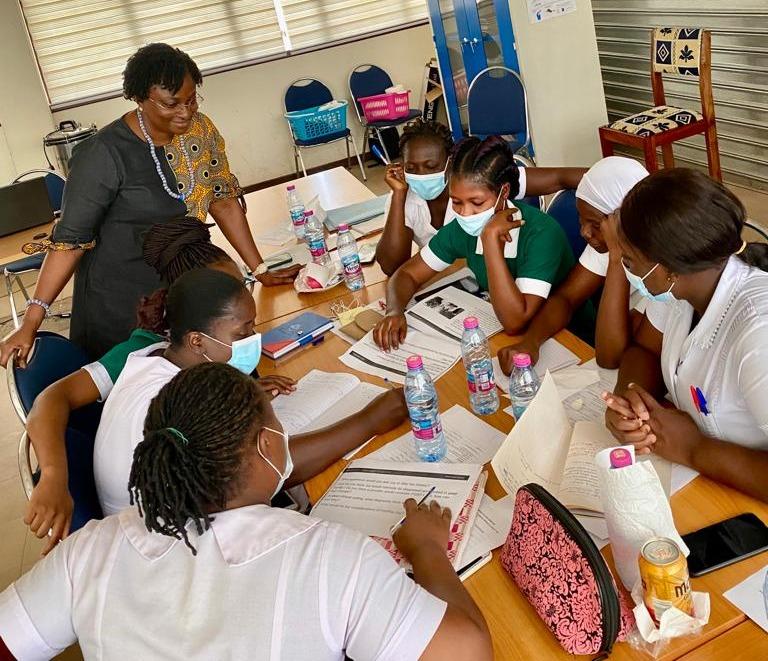
Women create activity plans for FGS in their local wellness heart in Accra, Ghana. Photo courtesy of Julie Jacobson
Through the workshop and the FAST Project more more often than not, we are trying to prevent this tragedy from repeating. Just, the fight against FGS brings promise and frustration in equal measure. There is promise because there is a safe, inexpensive drug called praziquantel that can treat schistosomiasis infections with a unmarried dose, improving symptoms and reducing suffering. In partnership with the Earth Health Organization, Merck KGaA donates praziquantel for use in pre-school and schoolhouse age children. It's provided through mass treatment programs in sub-Saharan Africa, most commonly through schools and local health organizations. These programs accept made swell progress using the drug, but this progress has been threatened over the past ii years. Targeted efforts to fight schistosomiasis through mass treatment campaigns have experienced significant disruptions due to the COVID-19 pandemic. This setback is magnified past the many missed opportunities to simply integrate schistosomiasis handling and prevention into existing routine health interventions to reach at-risk women and girls outside of schools.
With pandemic restrictions starting to ease, at that place is an opportunity to do more restart mass treatment campaigns. We should as well embrace toll-effective means to make rapid progress past embedding treatment and prevention inside programs that target diseases that take a clear connectedness to women and girls at take a chance for FGS. For example, women with FGS are three to iv times more than probable to become infected with HIV and often experience higher HIV viral loads, every bit well. That should make FGS diagnosis and treatment a priority in programs supported past the U.S. President's Emergency Plan for AIDS Relief (PEPFAR) and the Global Fund.
Programs for cervical cancer prevention and screening—efforts to reach girls for vaccination against Human Papilloma Virus (HPV)—offer another avenue. Evidence of FGS tin can hands be detected during these screening programs and praziquantel tin can exist distributed if needed. Interventions that focus on sexually transmitted infections should consider FGS during patient evaluations, specially when infections accept not resolved afterwards sexually transmitted infection (STI) treatment. In fact, a single dose of praziquantel should be standard practice when seeing untreated women and girls in health clinics in areas where the schistosomiasis parasite is common, regardless of whether the patients are currently showing symptoms.
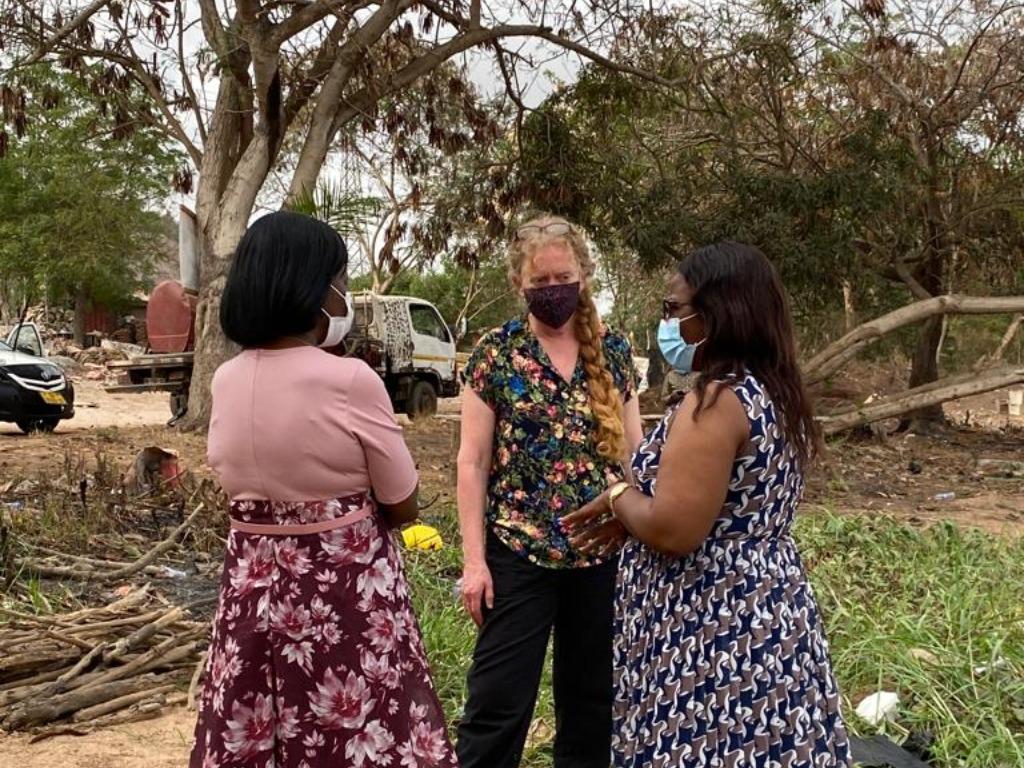
The author (middle) and her colleagues look at potential transmission risk factors well-nigh the Weija Dam on a field visit in Weija, Republic of ghana. Photo courtesy of Julie Jacobson
To contrary the tide, in that location is an urgent need for data campaigns targeting health professionals. Physician Hameedat Omoyele-Abdussalam, an OB/GYN in Nigeria, said she was never taught about FGS in school. She was proudly role of documenting the starting time FGS cases in Nigeria in 2016 and is now championing efforts to inform her colleagues and new medical students of the risk so women and girls are no longer misdiagnosed.
Public education efforts must also achieve women and girls, to assistance them sympathize the symptoms of FGS and seek out proper care equally soon as possible and participate in mass treatment programs where they are provided. To reach this goal in Nigeria, medico Ibrahim Rabiu, along with Omoyele-Abdussalam, is launching a new FGS Society to help prevent and treat FGS beyond the land, informing wellness practitioners and sensitizing at-risk populations.
FGS has been especially disregarded within the already marginalized world of neglected tropical diseases. WHO Manager-General Tedros Adhanom Ghebreyesus referred to FGS as the "silent and neglected scourge in sexual and reproductive health in Sub-Saharan Africa."
As nosotros emerge from the worst days of COVID-19 and resume wellness interventions that were slowed or suspended during the pandemic, nosotros need to accept stock of blind spots that existed before the pandemic and motion chop-chop to correct them. Information technology'due south specially of import to target diseases that have such a pregnant impact on women. The link between FGS and HIV risks alone should be sufficient enough to warrant more attending, given how African women and girls are disproportionately affected past HIV. A new grouping is meeting to try to fill the gap and observe the opportunities, the FGS Integration Group (FIG)—information technology links HIV partners, those fighting cervical cancer, and NTD partners to integrate FGS into existing programs to reduce unnecessary suffering.
FGS is low-hanging fruit when it comes to addressing disparities in women'due south health. The treatment is cheap and constructive, and it tin can be hands administered anytime a health-care provider is dealing with anything related to HIV, cervical cancer, STIs or just a routine visit. The biggest bulwark is a lack of awareness of the problem. In that sense the cure is not so much a drug. Rather, it's seeking a remedy for the somewhat puzzling condition in which a disease that affects tens of millions of women somehow manages to be hiding in plain sight.

A giant 25-meters-long worm represents the parasitic worm that causes schistosomiasis. Pictured on Lake Leman for the Neglected Tropical Diseases Meridian, in Geneva, Switzerland, on April eighteen, 2017. REUTERS/Pierre Albouy
Source: https://www.thinkglobalhealth.org/article/hiding-plain-sight
0 Response to "The People makingschistory the Global Fight Agains Schistosomiasis"
Post a Comment